QA Engineering Won the War Why AI Is Shifting Engineering From Building to Validation

For most of our industry’s history, the people with the most authority were the people closest to the act of building.
They were the ones who could design the abstraction, explain the trade-off, and write the code that made the system move. We built an entire professional identity around that model. Craft mattered. Elegance mattered. Readability mattered. The engineer was not just the person who shipped the thing. The engineer was the person who could defend every moving part of it.
That model made sense in a world where software was expensive to produce. When code was scarce, authorship was leverage.
AI changes that equation.
We can now generate plausible implementations faster than we can reason through every line of them with the same depth we used to. Not always good implementations. Not always safe ones. Not always maintainable ones. But plausible ones. Useful ones. Good enough to force a different question.
The hard question is no longer only, “Can we build this?”
It is, “Can we trust what was built?”
That shift fits the broader operating pattern in the research as well: modern engineering value already depends less on isolated acts of coding and more on systems of coordination, decision-making, guardrails, and quality across product, design, security, and operations.
AI moves the bottleneck from building to validation
That is why I think one of the strangest truths of the AI era is this: QA engineering won the war.
Not because the QA title suddenly became glamorous. Not because testing is new. And not because builders stopped mattering. They did not. But in a world where generation gets cheaper, validation becomes the scarce capability.
Once code is easier to produce, the leverage moves to the people who can evaluate it. The people who can define what “good” means. The people who can spot failure modes before they become incidents. The people who can tell the difference between an output that looks convincing and one that is actually safe, correct, and useful.
This is where many teams will get trapped. They will see AI increase output and assume the next move is simply more output. More features. More tickets. More code. But if generation scales faster than validation, you do not get a better engineering organization.
You get more review debt.
You get more plausible nonsense entering the system. More rework disguised as speed. More software that looked good in the editor and collapsed the moment it touched production reality.
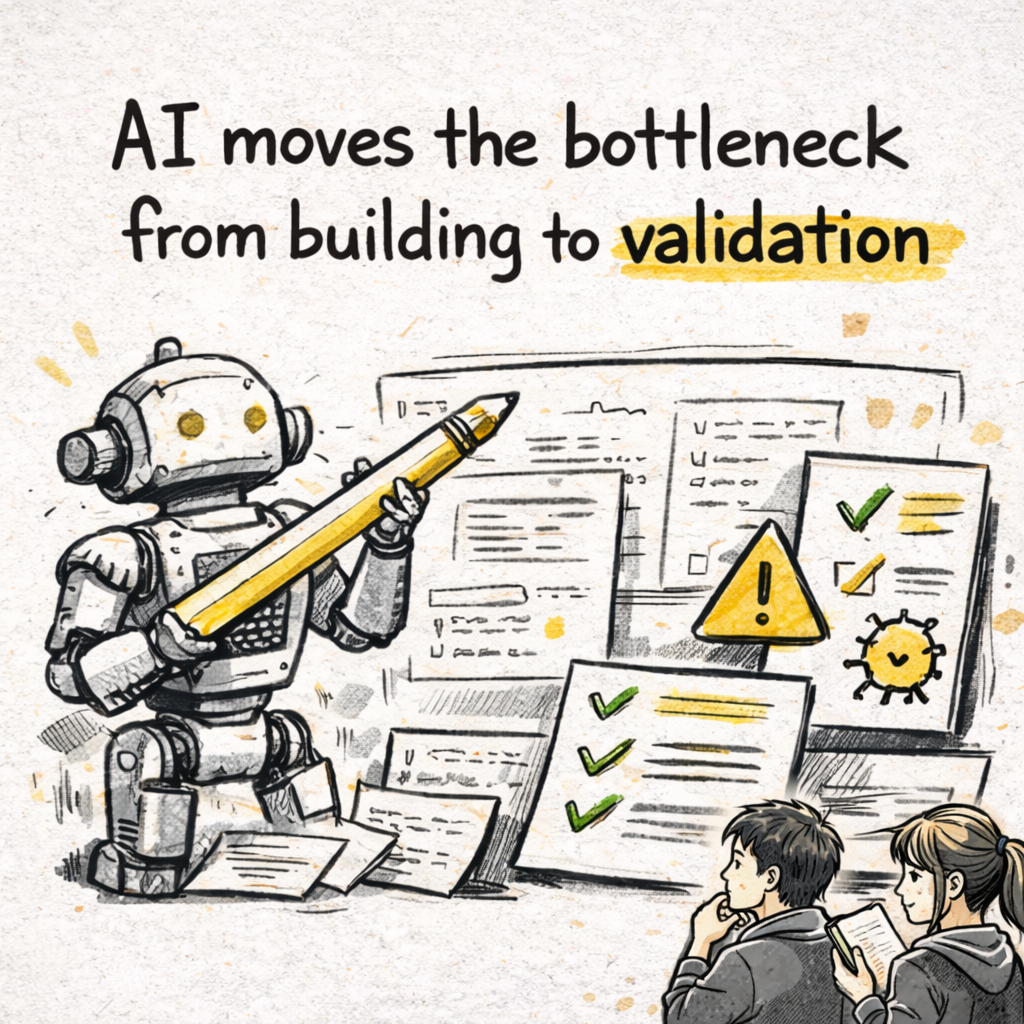
The bottleneck does not disappear.
It moves.
QA was never a phase. It was the real leverage.
For years, most organizations treated validation as downstream work. Product decided. Design designed. Engineering built. QA checked at the end.
That made QA look secondary, even though it was often the last place reality got a vote.
What we used to call QA was never just a final checkpoint. It was the part of the system that asked the hardest questions. Does this actually work under real conditions? What happens on the edges? What assumptions are hidden here? Where does this break? What are we missing because the happy path happens to look clean?
That mindset was never less important than building. It was just lower status.
But in a world where machines can generate working-looking code at scale, that status hierarchy starts to collapse. Validation stops being cleanup work. It becomes the work most tightly connected to value.
Test design matters more. Observability matters more. Release confidence matters more. Failure analysis matters more. The ability to challenge an output becomes more valuable than the ability to admire it.
So when I say QA engineers won the war, I do not mean the org chart did.
I mean the mindset did.
The new engineering model is judgment, guardrails, and domain knowledge
This is the real shift.
The future engineer looks less like a pure craftsperson and more like a judge.
Not a bureaucrat. Not a ticket approver. A judge.
Someone who can evaluate competing outputs under uncertainty. Someone who can decide what is good enough to proceed, what needs tighter constraints, and what should be rejected entirely. Someone who understands that the job is no longer just constructing the mechanism by hand, but designing an environment in which good mechanisms can be trusted and bad ones are caught early.
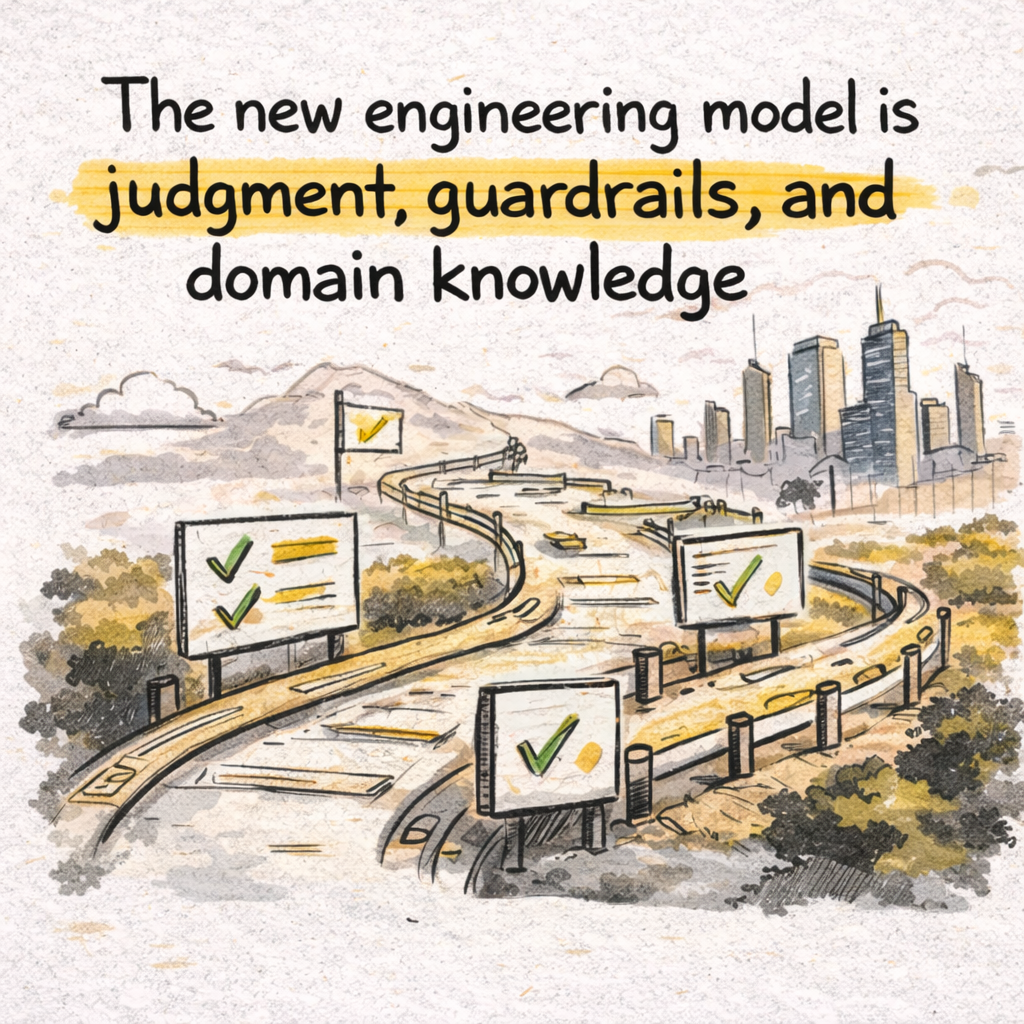
That is why the winning engineering model will not be more gates. It will be better guardrails.
The organizations that adapt will not respond to AI by piling on manual approvals forever. They will reduce handoffs, clarify ownership, automate policy where they can, and make the safe path the easy path. They will rely less on heroics and more on systems of validation that scale. That direction is already supported in the research: the operating models that hold up best are the ones that replace slow approval-heavy coordination with clearer decision rights, designed interfaces, and guardrails.
And this is also why domain knowledge becomes more valuable, not less.
AI will make generic implementation cheaper. It will make scaffolding easier. It will reduce the value of a lot of syntax-level labor. But it does not make context cheaper. It does not make business truth cheaper. It does not make accountability cheaper.
The hardest question in engineering was never only whether something could be implemented. It was whether that implementation reflected the real constraints around it: customers, regulation, security posture, operational limits, economic trade-offs, and failure costs.
When generation becomes abundant, contextual judgment compounds.
The engineer who understands the domain can interrogate machine output with force. One person asks, “Does this compile?” The other asks, “Does this survive contact with the business?”
Only one of those questions creates durable value.
QA engineering won the war
So yes, I believe that sentence.
QA engineering won the war.
Not because titles changed. Not because every company suddenly respects testing. Not because validation became fashionable.
They won because the center of leverage moved.
In the age of AI, building is cheaper.
Validation is not.
And the people, practices, and mindsets closest to validation are now sitting closest to real engineering advantage.
That is not a side effect of AI.
That is the new job description.